
Last updated July 10, 2026
Garage Door Repair Maintenance Checklist for Baltimore Homeowners
Every March, Michael’s phone starts ringing with the same story: “My door was perfect in November.” What happened? Three months of Baltimore freeze-thaw cycles turned a slightly worn roller into a seized track, or a minor spring tension issue into a complete system failure. The homeowners all ran the same generic “lubricate twice a year” checklist they found online. That checklist wasn’t wrong—it was just written for Phoenix or Portland, not for a city where January nights hit 18°F, March brings driving rain, and August humidity swells wooden doors until they stick in their tracks. This guide gives you a maintenance calendar built specifically for Baltimore’s four distinct seasons, the five-minute inspection that catches most problems before they become emergency calls, and honest guidance on when to put down the tools and call someone who works with high-tension springs for a living.
Quick Answer
Baltimore homeowners should inspect their garage doors monthly, with deeper maintenance timed to four seasonal triggers: pre-frost weatherproofing in October, mid-winter hardware checks in January, post-thaw alignment verification in March, and humidity-season lubrication in June. The five-minute visual inspection—checking rollers, cables, springs, and auto-reverse function—catches roughly 80% of developing problems before they require emergency repair.
Table of Contents
- The Baltimore Seasonal Calendar: When to Do What
- The Five-Minute Visual Inspection That Saves Emergency Calls
- What to Lubricate, What to Avoid, and Why WD-40 Damages Your Door
- Testing Auto-Reverse and Force Settings: The Safety Check Most Homeowners Skip
- Brand-Specific Wear Patterns: What We’ve Seen on LiftMaster, Craftsman, and Raynor Systems
- The DIY Boundary: When Maintenance Becomes Professional Repair
- Common Mistakes to Avoid
- When to Call a Professional
- Frequently Asked Questions
The Baltimore Seasonal Calendar: When to Do What
Generic checklists fail in Baltimore because they ignore the specific stresses our climate delivers. We’ve spent 11 years watching doors fail in Roland Park, Canton, and Hampden—and the patterns are predictable once you map them to actual weather.
October: Pre-Frost Weatherproofing
Before the first hard freeze, typically mid-to-late November in Baltimore, we prep doors for what’s coming:
- Inspect bottom seal and weatherstripping. Gaps here let in meltwater that refreezes on the threshold, creating ice dams that strain the opener. In Federal Hill and Fells Point, where rowhouse garages sit at sidewalk level, this is especially critical—street salt mixed with meltwater accelerates corrosion on aluminum bottom fixtures.
- Check track alignment. Summer humidity expansion and contraction may have shifted vertical tracks. A gap wider than ¼ inch between track and roller means the door will bind when metal contracts in cold.
- Lubricate springs and hinges with lithium-based grease. Not general-purpose spray—see the lubrication section below for why this matters in Baltimore’s humidity.
- Test manual release. If your opener’s emergency cord is stiff or corroded, you’ll discover it when the power fails during a January ice storm.
January: Mid-Winter Hardware Check
The coldest month is when metal fatigue shows itself. We schedule our own maintenance calls for existing customers in early January because this is when torsion springs snap from accumulated cold-weather brittleness.
- Listen for new noises: grinding suggests roller wear; popping indicates spring coil separation; squealing usually means dry bearings.
- Check cable fraying at bottom fixtures—salt and moisture collect here.
- Verify door balance: disconnect opener and lift manually. If it won’t stay at waist height, spring tension has shifted.
In neighborhoods like Patterson Park and Highlandtown, where many garages are detached and unheated, we’ve seen doors freeze to the ground overnight. Never force the opener—this burns out the motor. Use a heat gun or call for emergency service.
March: Post-Thaw Alignment Verification
This is Michael’s busiest repair month. Freeze-thaw cycles shift concrete thresholds, expand and contract tracks, and reveal every weakness that developed over winter.
- Run the full door cycle and watch for wobble or hesitation at specific points.
- Inspect roller stems for rust—Baltimore’s March rain combined with residual road salt creates aggressive corrosion.
- Check opener chain or belt tension; cold months of heavy lifting may have stretched drive components.
- Re-lubricate all moving parts that were treated in October.
June: Humidity-Season Lubrication and Wood Door Care
Baltimore’s July-August humidity averages 70%+. For solid wood doors in historic neighborhoods like Mount Vernon or Guilford, this means swelling that sticks panels in their frames. For steel doors, it means accelerated oxidation at any scratch or dent.
- Apply silicone-based lubricant to weatherstripping to prevent sticking.
- For wood doors: check panel gaps; if the door has swollen shut, don’t force it—adjustment or planing may be needed.
- Inspect for rust bloom on lower door sections, especially if your driveway slopes toward the garage.
The Five-Minute Visual Inspection That Saves Emergency Calls
We estimate 80% of the emergency calls we receive in Baltimore could have been prevented with a monthly five-minute inspection. Here’s exactly what to look for, in order:
- Rollers: Are they rolling or sliding? A roller that sits still while the door moves is a failure in progress. Nylon rollers crack; steel rollers flatten. Either way, the door is now grinding metal against metal. Look for cracks, flat spots, or wobble in the roller stem.
- Cables: Follow the lift cable from bottom bracket to drum. Fraying—any visible separation of strands—means the cable is operating at reduced capacity. A snapped cable under load is dangerous; this is not a DIY replacement.
- Springs: Look for gaps in torsion spring coils, rust streaks, or a noticeable tilt to the spring body. Extension springs should have intact safety cables running through them. If you see daylight between coils when the door is closed, the spring has lost tension.
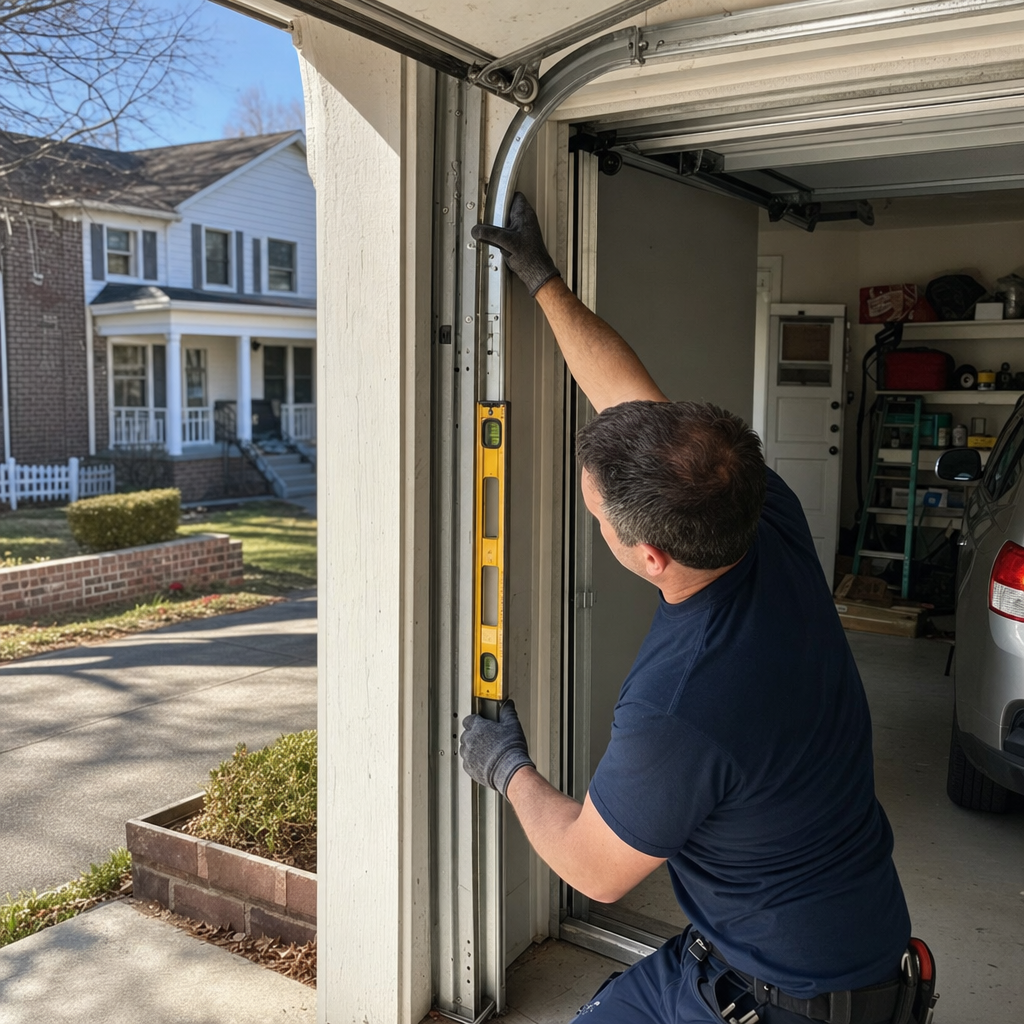
- Track condition: Check for dents, especially at the horizontal curve where doors transition from vertical. A dent here causes the exact binding that burns out openers.
- Door balance: With the opener disconnected, lift to waist height. A properly balanced door stays put. If it rises or falls, spring tension is wrong—and the opener is working overtime.
In our experience across Baltimore, from new construction in Harbor East to 1920s carriage houses in Roland Park, the most commonly missed sign is roller wear. Homeowners hear noise and lubricate; what they needed was replacement. Lubrication of a cracked roller just makes it slide more quietly as it destroys the track.
What to Lubricate, What to Avoid, and Why WD-40 Damages Your Door
We see this mistake constantly: a homeowner sprays WD-40 on every moving part, feels good about maintenance, and six months later has a door that runs worse than before. Here’s why, and what to use instead.
WD-40 is not a lubricant. It’s a water displacement formula with light penetrating oil. It evaporates within days, leaves a gummy residue that attracts dust and grit, and in Baltimore’s humidity, that residue becomes an abrasive paste. We’ve cleaned it off more rollers and tracks than we can count.
What to use for Baltimore conditions:
- Lithium-based grease (white lithium): For springs, hinges, and metal rollers. Stays put through humidity, doesn’t wash off in rain, handles temperature swings from 18°F to 98°F.
- Silicone spray: For weatherstripping, plastic rollers, and nylon components. Prevents rubber from drying and cracking; won’t degrade synthetic materials.
- Garage door-specific lubricant: Products like Clopay Pro Lube or 3-IN-ONE Garage Door Lube are formulated for the exact duty cycle and temperature range.
Never lubricate: the track itself. Rollers need to roll, not slide in grease. Oiled tracks collect debris and actually increase friction. Wipe tracks clean with a dry cloth only.
For Beltway-adjacent homes in areas like Pikesville or Towson, where road dust is heavier, we recommend slightly more frequent cleaning of exposed grease points—every two months rather than quarterly.
Testing Auto-Reverse and Force Settings: The Safety Check Most Homeowners Skip
This is the one test that can prevent serious injury, and in 11 years, we’ve found maybe 15% of Baltimore homeowners perform it regularly. The auto-reverse function has been federally mandated since 1993, but sensors fail, settings drift, and older openers may lack the feature entirely.
The Two-Part Test (Perform Monthly)
- Photo-eye test: Start the door closing. Wave a broomstick through the sensor beam at knee height. The door must reverse immediately. If it doesn’t, check alignment first—sensors should face each other directly, with indicator lights steady, not blinking. Clean lenses with a dry cloth; Baltimore’s pollen season and garage dust coat them quickly.
- Contact-reverse test: Place a 2×4 flat on the ground where the door meets the floor. Close the door. It must reverse on contact with the board. If it doesn’t, the close-force setting needs adjustment.
Critical safety note: Do not attempt to adjust force settings on pre-1993 openers lacking auto-reverse. These units should be replaced. Do not bypass or disable safety systems under any circumstance. The springs and cables on your door store lethal tension; the auto-reverse is your last line of defense if a child or pet is in the path.
We’ve replaced openers in homes from Cedarcroft to Lauraville where homeowners “got used to” holding the wall button until the door closed—effectively overriding every safety feature. This is not acceptable. Call for service.
Brand-Specific Wear Patterns: What We’ve Seen on LiftMaster, Craftsman, and Raynor Systems
After 11 years and 117 reviews, we’ve worked on virtually every residential system in Baltimore. Different brands show predictable failure modes that informed maintenance can catch early.
LiftMaster and Craftsman (Chamberlain family): These openers dominate Baltimore suburbs like Timonium and Owings Mills. The gear and sprocket assembly wears at 8–12 years; early sign is a motor that runs while the door doesn’t move. The RPM sensor also fails with garage dust accumulation—symptom is a door that reverses immediately after starting. Monthly visual inspection of the drive gear (visible without disassembly on most units) catches this before catastrophic failure.
Raynor: Common in older Baltimore homes with original installations. The proprietary radio receivers on pre-2010 units are prone to interference from LED bulbs—a problem we’ve seen increasingly as homeowners retrofit garage lighting. If your remote works inconsistently, test with LED bulbs turned off. Raynor torsion springs also tend toward higher cycle ratings but more aggressive corrosion at the stationary cone; check for rust where the spring mounts to the center bracket.
Wayne Dalton: Their TorqueMaster spring system conceals springs inside a tube—safer for homeowners but requiring specialized knowledge for service. If you have this system, do not attempt spring adjustment. The winding tool is proprietary, and incorrect use releases stored energy without warning. We’ve handled TorqueMaster conversions for Baltimore homeowners ready for standard torsion systems.
Whatever brand is on your door, we know it. That’s not a slogan—it’s the result of showing up as the technician, not sending a subcontractor with a phone app for troubleshooting.
The DIY Boundary: When Maintenance Becomes Professional Repair
We’re direct about this because we’ve seen the aftermath of confident DIY attempts: doors that crash down, cables that whip loose, springs that release with enough force to embed in drywall. Here’s where the line sits.
Safely within DIY scope: visual inspection, lubrication of hinges/rollers/springs (not torsion springs themselves), track cleaning, photo-eye alignment, testing safety systems, weatherstripping replacement.
Professional territory—do not attempt:
- Torsion spring adjustment or replacement. These springs store enough torque to cause serious injury or death. The winding bars must fit precisely; the technique requires training. We’ve responded to emergency calls in Hampden and Remington where homeowners tried YouTube tutorials and ended up with a door off its tracks and a spring loose in the garage.
- Cable replacement. Lift cables are under constant tension. Even with the door “relaxed,” improper handling releases stored energy.
- Track realignment after impact. A dented or shifted track affects the entire door geometry. Forcing adjustment without understanding load distribution bends tracks further and strains the opener.
- Opener installation or electrical work. Beyond basic plug-in units, this involves high-voltage wiring and structural mounting that affects door balance.
The honest test: if the repair requires tools you don’t own specifically for garage door work, or if releasing your grip on any component would let it move unpredictably, stop. Summit Garage Door Installation Maryland offers free estimates in Baltimore—call (833) 991-6997.
Common Mistakes to Avoid
- Using WD-40 as a lubricant. We’ve covered this, but it bears repeating: in Baltimore’s humidity, this creates more problems than it solves. We see the gummy residue every spring.
- Ignoring the manual release cord. Test it before you need it. In a power outage during a February ice storm, a stuck release cord means you’re either prying the door open manually against the opener or waiting for electricity.
- Adjusting spring tension with a screwdriver. Extension springs have adjustment clips; torsion springs have winding cones. Neither is a “turn a few times” fix. Incorrect tension accelerates wear on the opener, cables, and door itself.
- Running the opener on an unbalanced door. If the door won’t stay at waist height when disconnected, the opener is compensating every cycle. This burns out the motor and strips drive gears. The $200 spring adjustment prevents the $600 opener replacement.
- Neglecting the exterior finish on steel doors. A scratch through the factory coating becomes a rust point within one Baltimore winter. Touch up with matching paint immediately.
- Assuming silence means health. A door that runs quietly because the rollers are sliding, not rolling, is in worse shape than a noisy door with functional components. Listen for the right sounds: smooth rumble of rolling, not scrape of metal.
- Waiting for total failure. The homeowner who calls when the door won’t open at all pays for emergency service and often needs more parts than the one who called when it first started hesitating.
When to Call a Professional
Call when you see cable fraying, spring gaps, door wobble, or opener strain. Call when the door has been hit by a vehicle, even if it still operates—impact damage to tracks and sections progresses unpredictably. Call when safety systems fail testing, or when your opener lacks auto-reverse entirely. Call when you’re uncertain whether a task is maintenance or repair; we’ll tell you honestly, and if it’s simple, we’ll explain how to handle it yourself.
Michael shows up—not a crew you’ve never met. From emergency repairs to full installations, one call covers it. Summit Garage Door Installation Maryland offers free estimates in Baltimore—call (833) 991-6997.
Frequently Asked Questions
Professional annual maintenance typically runs $120–$200 in the Baltimore market, depending on door size and system complexity. This usually includes full inspection, lubrication, safety testing, and minor adjustments. Many homeowners find that one professional visit in October, combined with the monthly five-minute inspection we outlined above, prevents virtually all emergency repairs. Call (833) 991-6997 for an exact quote—estimates are free.
You can handle monthly visual inspection, lubrication, weatherstripping replacement, and safety system testing. Torsion spring work, cable replacement, and track realignment after impact require professional training and specialized tools. In our experience, the homeowners who stay within this boundary save money; the ones who cross it often create damage that costs significantly more to repair.
Lubricate moving metal components twice yearly: October before first frost, and March after thaw. In high-humidity summer conditions, a light touch-up of weatherstripping with silicone spray in June prevents sticking. More frequent lubrication isn’t better—excess grease attracts debris, especially in Baltimore’s pollen-heavy spring and dusty construction seasons.
This is almost always humidity-related swelling of wooden doors or frames, or expansion of metal tracks in direct sun. In Baltimore’s August humidity, we’ve seen solid wood doors expand ¼ inch or more. Check panel gaps in June; if they’re tight, the door needs adjustment or the wood may require sealing. Steel doors with damaged bottom seals can also swell with moisture absorption in the insulation core.
For openers under 10 years old with single-component failure—gear assembly, circuit board, or safety sensor—repair is usually cost-effective at $150–$350. For units over 12 years, or those lacking modern safety features, replacement makes more sense. New LiftMaster and Chamberlain openers include battery backup (now required by Maryland code in new installations), smartphone connectivity, and improved encryption. We assess honestly; 11 years, 117 reviews, one standard.
Summit Garage Door Installation Maryland offers emergency garage door service for urgent, unplanned failures. Response time varies by season and call volume, but we prioritize doors that are stuck open (security risk) or stuck closed (vehicle trapped). The owner is the technician. That changes everything. Call (833) 991-6997 for current availability.
The Bottom Line
Baltimore’s freeze-thaw cycles, humidity swings, and coastal salt exposure demand a maintenance approach tuned to actual local conditions, not generic quarterly advice. Time your deeper maintenance to October, January, March, and June. Run the five-minute visual inspection monthly. Use lithium grease, not WD-40. Test your safety systems. Know where the DIY boundary sits—and respect it, because torsion springs and lift cables don’t forgive mistakes. The homeowners who follow this calendar spend less on repairs, face fewer emergencies, and get significantly longer life from their doors and openers. Those who wait for total failure pay for the lesson.
Ready for a professional assessment? Summit Garage Door Installation Maryland serves Baltimore with 11 years of owner-operated experience. Call (833) 991-6997 for your free estimate.
Written by Michael Brown, Owner & Lead Technician at Summit Garage Door Installation Maryland, serving Baltimore since 2015.