
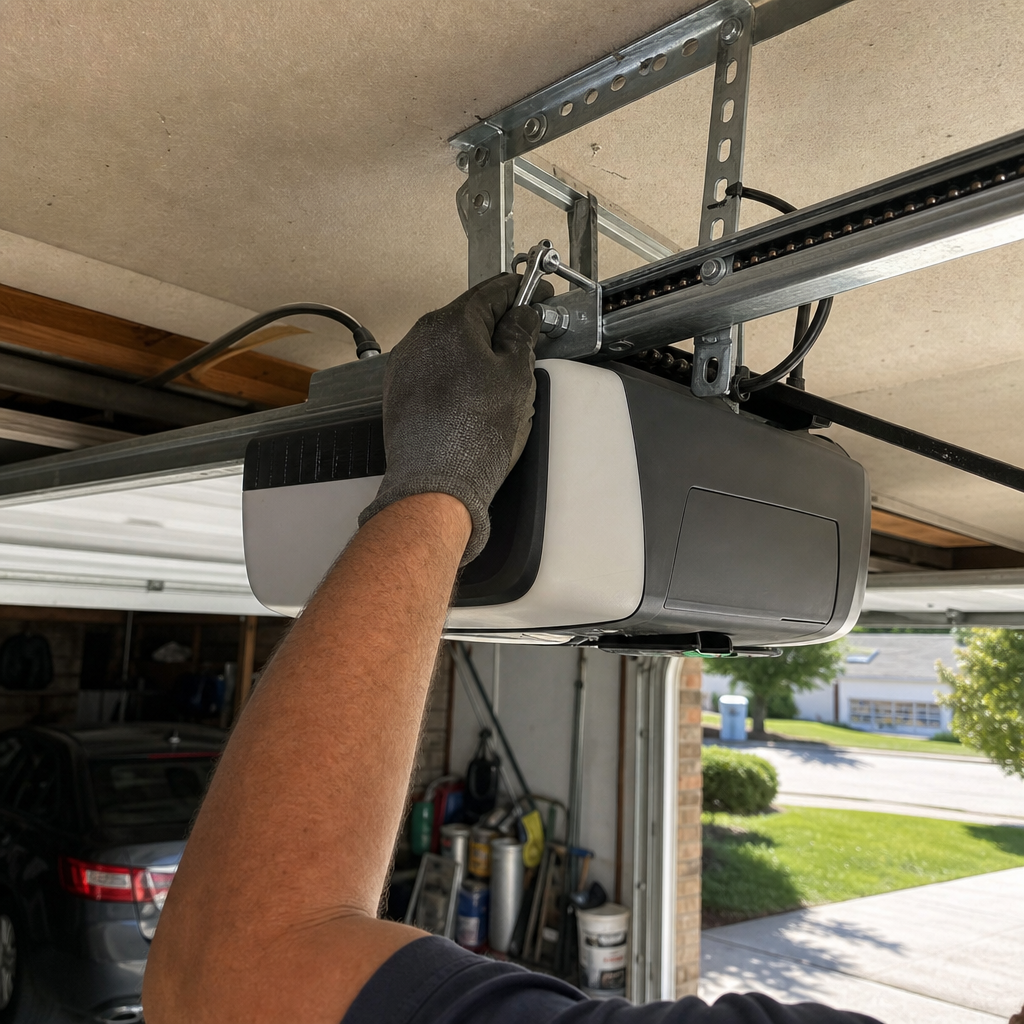
Garage Door Opener Installation in Maryland: What Actually Determines Whether It Works
Garage door opener installation in Maryland typically runs $250–$550 for a standard residential unit, and most jobs we handle are completed in a single visit. Call (833) 991-6997 for a free estimate — we carry the common models and hardware on our truck, so there’s no waiting on a second trip. What separates a clean install from one that rattles, strains, or fails inside two years comes down to three measurements most crews skip: your header clearance, your door’s actual weight, and whether your existing track can handle the drive type you’re buying.
We’ve lost count of the Maryland homeowners who’ve called us after a big-box opener “didn’t fit right.” The part that’s failing is usually not the part that gets blamed — let’s find the actual problem first. In eleven years of doing this work across Maryland, we’ve learned that the opener model matters far less than whether someone took the time to match it to your garage’s infrastructure before the box got opened.
The Three Measurements That Make or Break Your Install
Every opener installation starts with a tape measure, not a catalog. Here’s what we check before recommending any unit — and what gets overlooked when the goal is speed over fit.
Header Clearance: The Hidden Dealbreaker in Older Maryland Homes
Header clearance is the vertical space between the top of your garage door and the ceiling (or the nearest obstruction like ductwork or a beam). Standard openers need roughly 12–15 inches. But Maryland’s housing stock includes thousands of post-war ranchers in neighborhoods like Catonsville, Parkville, and Glen Burnie where garages were built with 8–10 inches of clearance — sometimes less.
When clearance is tight, a standard trolley-style opener will either not fit or will force the door into a steep angle that wears out rollers and hinges prematurely. The fix is a low-headroom track kit, which reconfigures how the door curves at the top of its travel. These kits aren’t included in retail opener boxes. We’ve seen franchise crews install standard openers into low-clearance garages anyway, leaving the homeowner with a door that shudders and a warranty that’s void because the installation violated manufacturer specs.
Michael Brown, our Owner and Lead Technician, carries low-headroom hardware on his truck specifically because this situation is so common in Maryland’s older neighborhoods. If we show up and your clearance is tight, we can modify the track on the spot — no callback, no “we’ll need to order parts.”
Door Weight vs. Opener Horsepower: The Math Most Skip
A ½-horsepower opener handles most single-car steel doors fine. But Maryland’s humidity swings — 80% summer days dropping to 30% in winter — cause wooden doors to absorb and release moisture, changing their weight by 10–15% seasonally. A solid wood carriage-style door, or a double-wide with insulation, can push past what a ½-HP unit should pull.
We weigh the door (or calculate it from thickness, material, and dimensions) before spec’ing horsepower. An underpowered opener works harder, runs hotter, and burns out its motor or strips its gears. We’ve replaced too many “defective” openers that were simply the wrong capacity for the door they’d been bolted to.
Drive Type: Chain, Belt, Screw, or Direct — What’s Actually Right for Your Door
Each drive type has a personality, and matching it to your door and your tolerance for noise matters:
- Chain drive: Most affordable, most durable, loudest. Fine for detached garages or if noise doesn’t bother you. We install a lot of these in rural Maryland properties where the garage sits back from the house.
- Belt drive: Quieter, slightly more expensive, requires precise tension. Best for attached garages under bedrooms. The belt material matters — reinforced rubber belts last longer than basic polymer.
- Screw drive: Fewer moving parts, but sensitive to temperature swings. Maryland’s freeze-thaw cycles can cause lubrication consistency issues. We rarely recommend these anymore unless a homeowner specifically requests one.
- Direct drive (wall-mount/jackshaft): Mounts beside the door instead of overhead, freeing ceiling space. Requires torsion springs in good condition and adequate side-room. Excellent for high-clearage or cathedral-ceiling garages, but not every door geometry accepts them.
The wrong drive type for your door’s mechanics creates unnecessary wear. We’ve seen belt drives installed on doors so heavy they stretch the belt inside eighteen months. We’ve seen direct drives mounted to doors with failing torsion springs, forcing the opener to do work the springs should handle — burning out the motor and creating a safety hazard.
Why LiftMaster and Chamberlain Dominate Our Maryland Installs — And What to Know
LiftMaster and its consumer-line sibling Chamberlain are what we’re asked about most when homeowners search for the Best Garage Door Opener in Maryland, MD, and for good reason: they’re reliable, parts are available, and the myQ ecosystem actually works for remote monitoring and Amazon Key deliveries. But these units come with installation variables that trip up inexperienced installers.
Battery backup is now code in many Maryland jurisdictions for new construction and replacement installs — not because of a state mandate, but because local amendments to the International Residential Code have adopted the requirement in several counties. We verify whether your jurisdiction requires it before quoting. A battery-backup model costs more upfront but avoids a failed inspection if you’re selling your home or finishing a renovation.
Safety sensor alignment on LiftMaster/Chamberlain units is finicky. The LEDs on the sensors tell a story — steady glow means aligned, two flashes means misaligned, four flashes means wiring fault — but we’ve found sensors “aligned” by previous installers that would trip on strong afternoon sun hitting the receiver. Maryland’s low winter sun angle creates this problem frequently on east-facing garages. We test under real conditions, not just at installation time.
myQ connectivity requires a stable 2.4 GHz WiFi signal at the opener location. Many Maryland garages have weak signal because the router sits at the opposite end of a rancher or because the garage walls contain foil-faced insulation that blocks signal. We check this before promising app functionality — and we’ll tell you if you need a WiFi extender rather than selling you an opener that won’t connect reliably.
Whatever brand is on your door, we know it. Our experience with Wayne Dalton torqueMaster systems, Craftsman rebadged units, and Raynor dealer-exclusive models means we can match an opener to your existing hardware without compatibility surprises.
What You Can DIY — And What Voids Your Warranty or Risks Injury
We get this question honestly: “Can’t I just buy the opener and put it in myself?”
Some tasks genuinely are homeowner-friendly. Remote programming, keypad setup, and light bulb replacement are designed for DIY — follow the manual, don’t force anything. If you’re stuck, our guide on How to Program Garage Door Opener? (Maryland, MD) can help. Travel limit adjustment after seasonal settling is also reasonable if you’re methodical.
But the core installation involves spring-loaded rail tension and safety sensor wiring that carry real risks. The rail assembly on a sectional opener stores significant tension; releasing it improperly can cause lacerations or eye injuries. Safety sensors must be wired to the correct terminals and positioned 4–6 inches above the floor — any higher and small children or pets pass underneath undetected. Miswired sensors can reverse the safety function, making the door continue rather than stop when obstructed.
More practically, most manufacturer warranties require professional installation for full coverage. A self-install that results in stripped gears or motor failure often leaves you buying a second unit out of pocket. Our $250–$550 install range includes the expertise that keeps your warranty intact and your door safe.
| Service | Price Range |
|---|---|
| Opener Installation | $250 – $550 |
| Opener Repair | $120 – $320 |
| Spring Repair | $180 – $340 |
| Cable Repair | $130 – $250 |
| Track Realignment | $120 – $240 |
| Roller Replacement | $110 – $220 |
| Panel Replacement | $250 – $500 |
| New Door Installation | $700 – $2,200 |
| General Garage Door Repair | $150 – $600 |
How Our Process Works: From Phone Call to Working Door
When you call (833) 991-6997, we schedule a site visit — usually within a day or two, faster for urgent situations. Michael shows up — not a crew you’ve never met. He measures your door, checks your header clearance, tests your existing spring balance, and verifies electrical availability at the opener location.
We quote upfront, with the opener model and any track modifications itemized. No “we’ll see how it goes” pricing. If your door needs a low-headroom kit, we carry it. If your spring tension is off and will kill the new opener, we tell you before installing anything. From emergency repairs to full installations — one call covers it.
The install itself typically takes 2–3 hours for a standard replacement, 3–4 for a new location or a conversion from manual to automatic. We test every function — remote, wall button, safety reverse, force settings — and we don’t leave until you understand how your specific system works.
Key Takeaways
- Opener installation in Maryland runs $250–$550 — the variance depends on horsepower, drive type, and whether track modifications are needed.
- Header clearance, door weight, and drive type compatibility are the three pre-install checks that prevent premature failure.
- Older Maryland homes frequently need low-headroom track kits that retail opener boxes don’t include.
- LiftMaster/Chamberlain’s myQ, battery backup, and sensor alignment have specific installation requirements we verify on-site.
- DIY-friendly tasks exist, but core installation involves safety risks and warranty implications best handled by a trained technician.
- Michael Brown serves as both owner and lead technician — direct accountability, no subcontractor roulette.
FAQs
Most residential Garage Door Opener Near Me in Maryland, MD installations fall between $250 and $550, including the opener unit, hardware, and labor. The price moves toward the higher end if you need a low-headroom track kit, battery backup for code compliance, or a higher-horsepower unit for a heavy wooden door. Call (833) 991-6997 for an exact quote — estimates are free.
Same-day installation is often possible if we’ve confirmed your door’s measurements and compatibility during a preliminary call, and if we’re already in your area. We carry common LiftMaster and Chamberlain models plus low-headroom hardware on our truck, so most standard jobs don’t require a parts run. For the fastest scheduling, call (833) 991-6997 — we’ll tell you honestly if we can make it today or if your door needs measurements first.
Repair makes sense when the issue is isolated — a failed circuit board, stripped gear, or misaligned sensor typically runs $120–$320, well under replacement cost. But if your opener is over 12–15 years old, lacks safety features required by current code, or has needed multiple repairs, installation of a new unit is usually the better investment. We don’t replace parts that don’t need replacing — we’ll show you what’s actually wrong and let you decide.
You can handle remote programming, keypad setup, and basic maintenance yourself. But the rail assembly tension, safety sensor wiring, and force-setting calibration involve real injury risk and typically void manufacturer warranties if done incorrectly. We recommend professional installation for the core mount and electrical work — the cost difference is small compared to replacing a failed DIY install or handling an injury.
Ready for a Door That Actually Works?
11 years, 117 reviews, one standard. If you’re tired of quotes that don’t add up or installs that fail inside a year, call (833) 991-6997 for a free estimate. Michael will show up, measure what matters, and tell you exactly what your garage needs — no more, no less. From our home base across Maryland, we’re the owner-operated alternative to franchise crews and revolving-door subcontractors. For everything from Garage Door Opener service to full new installations, Summit Garage Door Installation handles it start to finish.
Written by Michael Brown, Owner & Lead Technician at Summit Garage Door Installation Maryland, serving Maryland, MD.