
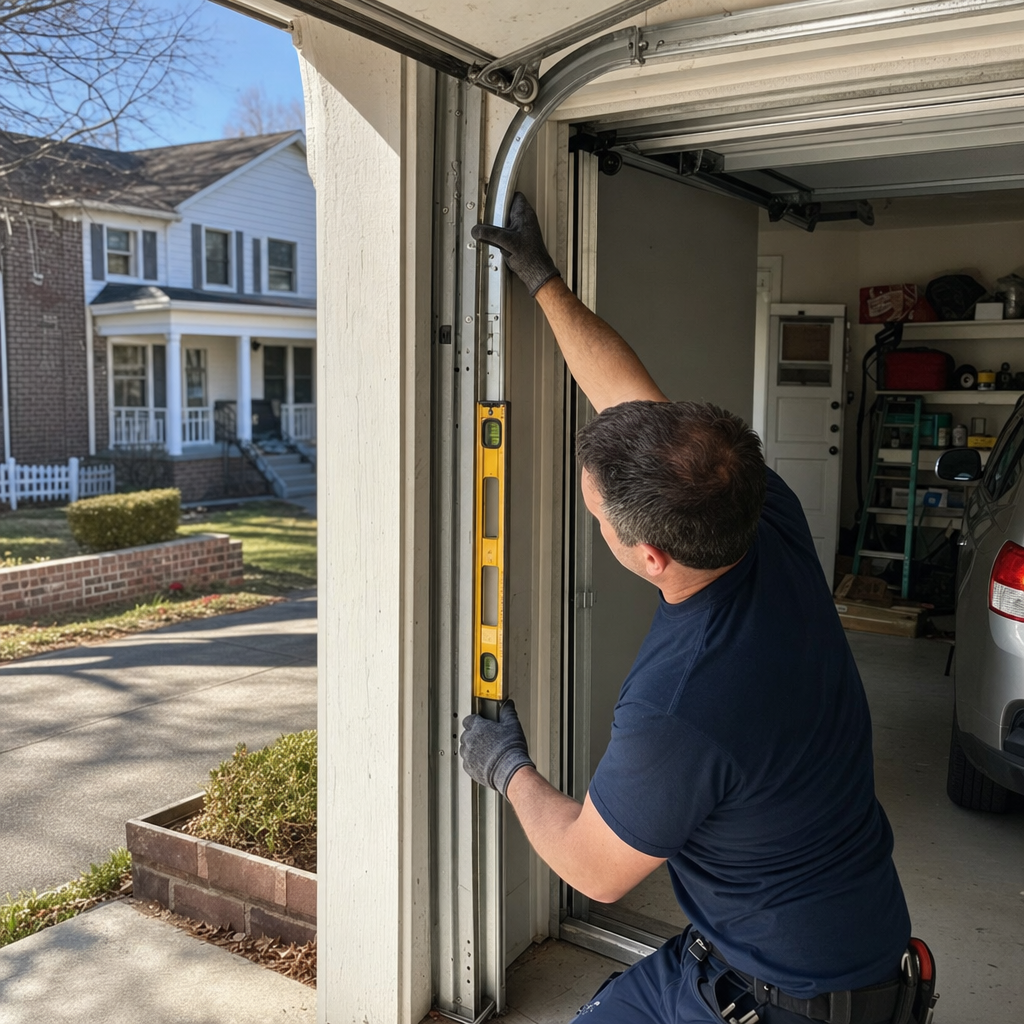
Why Does My Garage Door Reverse in Maryland? The Four Actual Causes
A garage door that reverses while closing is almost always caused by one of four things: the down-force limit set too low, the close-force sensitivity misadjusted, safety sensor misalignment, or a failing opener logic board. In Maryland’s climate, sticky door seals from cold January mornings are also a common seasonal trigger that mimics a mechanical problem. If you’re dealing with a door that won’t stay closed, call Summit Garage Door Installation Maryland at (833) 991-6997 for a same-day diagnosis — estimates are free.
Here’s the thing most online advice gets wrong: they lead with “clean your sensors” because it’s easy to write. But after eleven years and thousands of service calls across Maryland, we’ve found dirty lenses cause maybe one in five reversals. The part that’s failing is usually not the part that gets blamed — let’s find the actual problem first.
How Maryland’s Climate and Housing Shape Garage Door Problems
Maryland’s freeze-thaw cycle hits garage doors harder than homeowners expect. In Catonsville, Ellicott City, and the older neighborhoods around Annapolis, we regularly see doors installed in the 1990s with original openers now struggling against swollen wood frames and concrete that shifts slightly with temperature swings. The humidity doesn’t help either — metal components corrode faster here than in drier inland climates.
Michael Brown, our Owner and Lead Technician, grew up working on the exact kind of homes we still service in Catonsville — older construction with character, but also with settling foundations and door frames that aren’t quite square anymore. That background matters when a door reverses not because one thing broke, but because three minor factors stacked together: a slightly worn spring, a seal that’s gripping the floor, and an opener still calibrated for when the door was new.
The Four-Cause Diagnostic Tree: What to Check in Order
When a door reverses, most homeowners understandably want a quick fix. But jumping straight to sensor cleaning skips the actual logic of how an opener thinks. Here’s the sequence we use on every call, and what you can safely check yourself before calling.
Cause 1: Down-Force Limit Set Too Low
This is the most common culprit we see in Maryland, especially after a DIY installation or a handyman visit where the opener wasn’t properly calibrated to the specific door weight.
The down-force limit tells the opener how much resistance is “normal” when the door reaches the floor. If it’s set too conservatively, the door hits the concrete and the opener interprets that contact as hitting an obstruction — so it reverses. The door isn’t actually hitting anything; the opener just thinks it is.
On LiftMaster and Chamberlain openers — the two brands we see on roughly 60% of Maryland homes — the down-force adjustment is a small white dial on the left side of the motor housing (looking from the back). It’s labeled “CLOSE” or sometimes “DOWN.” A quarter-turn clockwise increases the force threshold; counter-clockwise decreases it. One quarter-turn is usually the difference between a door that reverses and one that seats properly.
What we watch for: If you’ve already turned this dial more than two quarter-turns and the door still reverses, stop. You’re not fixing a calibration problem — you’re masking a mechanical issue, usually a spring that’s lost tension or a door that’s become unbalanced. Continuing to increase force will burn out the opener motor within months. That’s when you need a professional spring assessment, not another dial turn.
Cause 2: Close-Force Sensitivity Too High (Or a Worn Spring)
This is where diagnosis gets interesting, and where most generic advice falls apart.
The close-force sensitivity monitors torque during the entire closing cycle, not just at the end. If your spring is worn — and in Maryland, springs typically last 8-12 years depending on cycle count — the opener motor works harder to pull the same weight. The torque sensor reads that extra effort as resistance and triggers a reversal.
Here’s the critical distinction from Cause 1: a down-force problem reverses at the floor. A close-force problem reverses mid-travel, often at the same spot every time, usually where the door is heaviest in its arc.
The close-force dial sits next to the down-force dial on LiftMaster and Chamberlain units, labeled “FORCE” or “SENSITIVITY.” Same quarter-turn increments. But we strongly recommend against adjusting this yourself — here’s why:
- A worn spring is a safety hazard. Garage door springs hold hundreds of pounds of tension. A broken spring can cause serious injury or property damage.
- Increasing close-force to compensate for spring wear accelerates motor failure and creates a door that won’t reverse if it actually hits something.
- The auto-reverse feature exists because a closing garage door can injure a person or pet. A door that reverses erratically is a system working correctly — it’s telling you something needs attention.
Spring repair in Maryland typically runs $180–$340. Opener repair if you’ve already damaged the motor with over-adjustment adds $120–$320. The math favors fixing the actual problem.
Cause 3: Safety Sensor Misalignment (The Over-Indexed Cause)
Yes, misaligned or obstructed safety sensors cause reversals. But let’s be specific about how to confirm this, because “check your sensors” is advice that wastes a lot of time when the real problem is mechanical.
The sensors are the two small boxes mounted 4-6 inches off the floor on either side of the door track. They beam an invisible signal across the door opening. If that beam breaks — or if the sensors can’t “see” each other because they’re misaligned — the opener reverses immediately, usually within a foot of travel.
How to test accurately:
- Look for the LED lights on each sensor. On most LiftMaster and Chamberlain units, one shows amber (sending) and one shows green (receiving). Both must be solid — not flickering, not off.
- If the green light is out or flickering, the receiving sensor can’t see the beam. Check for physical obstruction first: leaves, spider webs, snow melt puddles, or that storage bin you moved last week.
- If nothing blocks the path, loosen the wing nut on the receiving sensor and adjust it slightly until the green light holds steady. Even 1/8 inch of misalignment matters.
- Sunlight directly hitting the receiver can blind it. In Maryland, this happens most on west-facing garages between 4-6 PM in summer. A small cardboard hood taped above the sensor fixes this.
If both LEDs are solid and the door still reverses, your sensors aren’t the problem. Don’t keep adjusting them — move to Cause 4 or call for a mechanical diagnosis.
Cause 4: Logic Board Fault (Rare, But Real)
On openers over 12 years old — common in Maryland’s established neighborhoods like Roland Park, Takoma Park, and the older parts of Silver Spring — the logic board can develop intermittent faults that cause phantom reversals.
The logic board is the computer that processes signals from the force sensors, the safety sensors, and the remote. When it fails, it may misread normal operation as an obstruction, or it may reverse the door at random intervals with no pattern.
Signs pointing to logic board failure:
- Door reverses at random points, not the same location each time
- Wall button works but remote is intermittent, or vice versa
- LED lights on the motor unit flash in patterns not matching any error code in the manual
- Problem started after a power surge or lightning storm (Maryland summer thunderstorms are notorious for this)
Logic board replacement runs $120–$320 for parts and labor, but on units over 15 years old, we usually recommend Garage Door Repair evaluation for full opener replacement. New opener installation ranges from $250–$550 and gets you modern safety features, quieter operation, and smartphone connectivity that the old unit can’t support.
The Maryland Seasonal Factor: When It’s Not Actually Broken
Here’s a cause that doesn’t appear in any generic troubleshooting guide because it’s specific to cold climates with freeze-thaw cycles: your door seal is frozen to the concrete.
On Maryland’s coldest January mornings — especially in shaded driveways or north-facing garages in places like Frederick or Westminster — the rubber bottom seal can freeze to the slab. When the opener tries to lower the door, the initial resistance of breaking that seal triggers the force sensor. The door reverses, and you assume something’s wrong with the opener.
The fix is simple: Before calling for service, pour warm (not boiling) water along the door threshold, or use a hair dryer on low to soften the seal. Once free, apply a thin layer of silicone spray to the seal bottom — we use this on our own service vehicles and recommend it to Maryland customers every November as preventive maintenance.
If this happens repeatedly, the seal may be worn and gripping more aggressively. Home seal replacement is a quick service call, typically under $150 if done with other maintenance.
What Professional Calibration Actually Involves
When Michael shows up for a reversal diagnosis, we don’t guess. Our process:
- Door balance test: We disconnect the opener and lift the door manually. A properly balanced door stays at any height you leave it. If it falls or rises on its own, the spring system needs attention before any opener adjustment.
- Travel limit verification: We measure where the door actually stops versus where it should stop, then adjust the open and close limits precisely.
- Force calibration with a 2×4: Federal safety standard requires that a door reverse within 2 seconds of contacting a 1.5-inch obstruction. We test this with a wooden block — not eyeballing, actually measuring.
- Brand-specific diagnostics: For Genie openers, which we see frequently in newer Maryland construction, the force settings are digital, not dial-based. For Raynor units, the limit switches are in a different physical location. Whatever brand is on your door, we know it.
Full diagnostic and adjustment service falls within our standard $150–$600 repair range, with most calibration-only visits at the lower end. If we find a spring or cable issue during the same visit, we itemize everything before starting work — no flat-rate mystery pricing.
Key Takeaways: When to Adjust, When to Call
- Down-force adjustment at the floor: one or two quarter-turns is safe to try yourself
- Mid-travel reversals or repeated failures after adjustment: call before damaging the motor
- Solid sensor LEDs but still reversing: mechanical problem, not sensor problem
- Random reversals on older openers: possible logic board, worth professional evaluation
- January frozen seals: try warm water and silicone spray first
- Any spring or cable concern: this is genuinely dangerous — the owner is the technician, and that changes everything when safety is involved
FAQs
Most reversal repairs in Maryland cost between $150 and $340, depending on whether it’s a simple calibration or requires spring replacement. Opener logic board replacement runs $120–$320, and full opener installation is $250–$550. Call (833) 991-6997 for an exact quote — estimates are free.
Repair is usually cheaper for openers under 10 years old with isolated issues like sensor misalignment or limit calibration. Replacement makes more sense when the opener is over 15 years old, has repeated logic board failures, or lacks modern safety features. We evaluate both options honestly — 11 years, 117 reviews, one standard.
Yes — we offer Emergency Garage Door Repair in Maryland, MD for urgent reversal issues, and Michael handles the majority of calls personally. Same-day availability depends on call volume, but we prioritize doors that won’t stay closed for security reasons. From emergency repairs to full installations — one call covers it.
Disconnect the opener and lift the door manually to about waist height. If it won’t stay there — either falling closed or rising open — the spring balance is off. Never adjust springs yourself; the stored tension can cause serious injury. This is when you need the decision-maker on-site, not a rotating subcontractor.
If you’d rather have it looked at, Summit Garage Door Installation Maryland offers Best Garage Door Repair in Maryland, MD with a no-pressure assessment — call (833) 991-6997.
Written by Michael Brown, Owner & Lead Technician at Summit Garage Door Installation Maryland, serving Maryland, MD.