
Why Your Garage Door Won’t Close in Maryland — And the One Question That Solves It Fast
A garage door that won’t close in Maryland is most often caused by misaligned safety sensors or an opener force setting thrown off by seasonal humidity changes. Most homeowners can spot the difference in under two minutes by asking one simple question before touching anything. If your door starts to move downward then reverses, read our guide on why does my garage door reverse — the problem is almost certainly sensor-related or a force-sensitivity issue. If it refuses to move at all, you’re looking at power, logic board, or manual disconnect problems — completely different territory. For same-day diagnosis anywhere in Maryland, call Summit Garage Door Installation Maryland at (833) 991-6997; estimates are free and Michael Brown, our Owner and Lead Technician, handles the call personally.
Maryland’s Climate Is Harder on Garage Doors Than Most People Realize
We’ve spent eleven years watching Maryland’s sticky summers and freeze-thaw winters do things to garage doors that the manufacturer’s manual never warned about. The humidity around the Chesapeake Bay and its tributaries — especially in low-lying pockets like Glen Burnie, Pasadena, and parts of Catonsville where Michael Brown grew up helping his father maintain older homes — causes wooden door sections to absorb moisture and swell by small but critical fractions of an inch. That swelling changes the door’s weight distribution, which can trigger force-sensitivity reversals on openers calibrated during drier winter months.
We’ve seen this exact scenario dozens of times: a door that worked fine in March starts reversing halfway down in July. The homeowner replaces sensors, adjusts limits, even swaps the opener — and the real fix was a seasonal force-sensitivity recalibration that takes ten minutes with the right tools. That’s the kind of local knowledge you don’t get from a franchise manual written in Phoenix.
Our Garage Door Repair in Maryland covers these seasonal adjustments, but the diagnostic path below will help you understand what’s actually happening before you call anyone.
The Diagnostic Split: “Starts and Reverses” vs. “Won’t Budge”
This is the fork in the road that eliminates five of the seven common causes immediately. We’ve learned to ask it first, every time, because guessing wrong sends you down an hour-long rabbit hole.
Path A: The Door Starts Downward, Then Reverses
If the door begins closing but rolls back up — sometimes a few inches, sometimes halfway — you’re in the sensor-force-obstruction family of problems. Here’s how to narrow it:
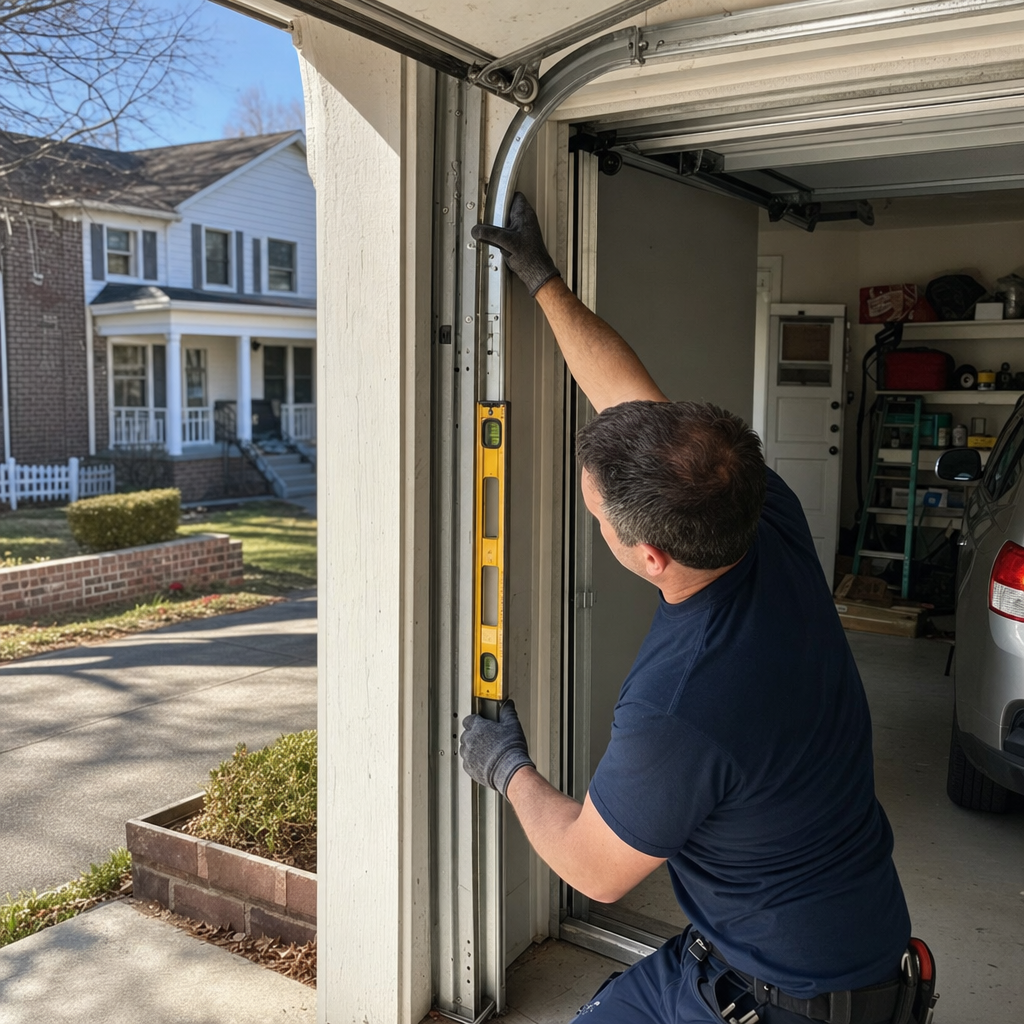
- Safety sensor misalignment: The sending sensor (amber/yellow LED) and receiving sensor (green LED) must be within roughly 1/4 inch of parallel alignment. The most common cause of drift isn’t impact — it’s a bracket bolt that vibrated loose over thousands of cycles. We’ve found sensors tilted 15 degrees off-axis that the homeowner never touched.
- Sensor path obstruction: Spider webs, leaf debris, or even condensation on the lens can break the infrared beam. Wipe both lenses with a dry cloth.
- Force sensitivity set too low: Maryland’s summer humidity swells wooden doors; the opener interprets the extra resistance as an obstruction and reverses. This is particularly common on 10-15 year old Craftsman and Chamberlain units with analog force pots that drift over time.
- Actual mechanical obstruction: A bent track section, seized roller, or debris in the vertical track. Run your hand along the inside of both tracks — you’ll feel it.
The part that’s failing is usually not the part that gets blamed — let’s find the actual problem first. We’ve replaced perfectly good openers when the real culprit was a $12 roller binding in a dented track section.
Path B: The Door Doesn’t Move At All
Complete refusal to move points to the control side, not the door mechanics:
- Manual disconnect engaged: That red cord hanging from the trolley? If it’s been pulled — sometimes by a kid, sometimes by accident during storage — the opener runs but the door doesn’t move. Re-engage by pulling the cord toward the opener and running the unit until the trolley locks.
- Opener has power but no logic: LED lights on the motor head but no response to remote or wall button often means a failed logic board. Common on Genie Intellicode units from 2012-2018 after power surges.
- No power at the outlet: Check your GFCI — garage outlets trip more often than people notice, especially in Maryland’s older housing stock with updated-but-not-rewired garages.
- Broken torsion spring: If you hear the opener motor strain or hum but the door stays put, look at the spring assembly above the door. A single broken spring on a two-spring system can leave the door too heavy for the opener. Do not keep running the opener — you’ll strip the nylon gear or burn the motor.
The Manual Disconnect Test: Separating Opener Problems from Door Problems
This is the most useful two-minute test we know, and most homeowners have never heard of it. Pull the red emergency release cord to disengage the opener trolley. Now try to lift and lower the door by hand.
If the door moves smoothly and stays put at any height: The door’s mechanical system — springs, cables, rollers, tracks — is fine. Your problem is 100% in the opener: power, logic board, limits, or force settings. Call us for opener repair; most runs $120–$320.
If the door is heavy, jerky, or won’t stay open: You’ve got a spring balance or cable issue. The opener isn’t the villain — it’s actually protecting itself by refusing to lift a door it wasn’t designed to handle. This is where DIY gets dangerous.
Safety note: Torsion springs store massive mechanical energy. A broken spring or failed cable can release that energy unpredictably. If one side of your door sits visibly lower than the other, or if you see a gap in the spring coil, stop immediately. Operating the door manually or forcing the opener can snap cables, bend tracks, crack door panels, or cause serious injury. This is not a YouTube-tutorial situation. Call Summit Garage Door Installation Maryland at (833) 991-6997 — Michael handles these calls personally and carries the correct spring stock for your door’s weight and height.
What This Actually Costs to Fix in Maryland
We don’t quote flat rates over the phone because “won’t close” covers too many scenarios, but here’s what Maryland homeowners typically pay after we diagnose the root cause:
| Repair Type | Typical Range | Most Common Cause of “Won’t Close” |
|---|---|---|
| Sensor realignment / bracket tightening | $120–$180 | Vibration-loosened bracket, summer humidity drift |
| Opener force-sensitivity recalibration | $120–$180 | Seasonal humidity swelling wooden door sections |
| Opener repair (logic board, gear, capacitor) | $120–$320 | Power surge, age-related component failure |
| Spring repair (torsion or extension) | $180–$340 | Metal fatigue, corrosion from garage moisture |
| Cable repair or replacement | $130–$250 | Fraying, improper tension after spring change |
| Roller replacement (set of 10) | $110–$220 | Seized roller causing force-triggered reversal |
| Track realignment or section repair | $120–$240 | Impact damage, hardware loosening |
Our full Garage Door Repair service covers everything from sensor tweaks to complete system rebuilds. We carry parts for LiftMaster, Chamberlain, Genie, and Clopay systems on every truck, so most jobs finish in a single visit.
Why Some “Simple” Fixes Fail Within a Year
We’ve been called to plenty of Maryland homes where a previous repair held for six months, then the same symptom returned. The pattern is predictable: a technician swapped the part that failed without asking why it failed.
A sensor bracket that vibrates loose once will vibrate loose again unless you address the underlying flex in the track mounting. A logic board that fried after a power surge needs a surge protector, not just a new board. An opener that “needs more force” every summer is telling you the door’s weight balance has shifted — maybe humidity, maybe a failing spring that’s adding load unevenly.
That’s why Michael still does the majority of service calls himself. When the owner is the technician, there’s no incentive to sell you a part you don’t need, and no gap between diagnosis and accountability. Eleven years, 117 reviews, one standard.
Key Takeaways: What to Check Before You Call
- Ask the split question first: does it start-then-reverse, or refuse to move? This eliminates most wrong guesses.
- Check sensor LEDs: steady glow means aligned; blinking or off means misalignment, obstruction, or wiring fault.
- Try the manual disconnect test to separate opener problems from door-mechanic problems.
- Look for uneven door height — a visible tilt means spring/cable failure; stop using the door immediately.
- Maryland’s summer humidity commonly triggers force-sensitivity reversals on wooden doors; this is a calibration, not a replacement.
FAQs
Most repairs run $150–$600 depending on the root cause, with sensor realignments and force recalibrations at the lower end ($120–$180) and spring or opener repairs toward the middle ($180–$340). We don’t charge diagnostic fees when you proceed with the repair, and we’ll explain exactly what failed and why before any work starts. Call (833) 991-6997 for a free estimate — Michael Brown handles the assessment personally.
Yes — we offer emergency garage door repair in Maryland, MD for doors stuck open or compromised, and we stock sensors, springs, cables, and logic boards for all major brands including LiftMaster, Chamberlain, and Genie. Same-day availability depends on call volume, but we prioritize security and weather-exposure situations. If your door is stuck open overnight or before a storm, call (833) 991-6997 and we’ll get you scheduled.
Repair is usually cheaper if the unit is under 10 years old and the failure is isolated — a $180 gear kit versus a $450 opener installation. We recommend replacement when the opener has multiple prior repairs, lacks modern safety features, or when the repair cost exceeds 60% of replacement. Michael will show you both options with honest numbers; we’ve talked homeowners out of unnecessary replacements more times than we can count.
Maryland’s humidity causes wooden door sections to expand, increasing the load on your opener and triggering built-in force-sensitivity reversals. The opener thinks it’s hitting an obstruction. A seasonal force recalibration — not a part replacement — fixes this in about ten minutes. We’ve seen this exact pattern in Catonsville, Ellicott City, and anywhere with older wood-paneled doors near the water.
When to Stop Troubleshooting and Call Summit
If you’ve checked sensors, tested the manual disconnect, and the door still won’t close — or if you’re seeing uneven door height, hearing grinding from the opener, or simply don’t want to risk making it worse — we’re a phone call away. Michael Brown shows up, not a crew you’ve never met. From emergency repairs to best garage door repair in Maryland, MD — one call covers it. Whatever brand is on your door, we know it.
Summit Garage Door Installation Maryland offers no-pressure assessments anywhere in Maryland. Call (833) 991-6997 for a free estimate, or visit our home page to learn more about our owner-operated approach.
Written by Michael Brown, Owner & Lead Technician at Summit Garage Door Installation Maryland, serving Maryland, MD.