
Last updated July 10, 2026
The Complete Guide to Garage Door in Baltimore
Most garage door guides are written for Phoenix or Dallas. Baltimore gets 14+ inches of snow, 90% summer humidity, and road salt drift from I-695 — none of which show up in the advice you’re reading from a national brand’s blog. We’ve spent 11 years watching doors fail in Roland Park, Canton, and Hampden, and the pattern is clear: generic recommendations cost homeowners double when Baltimore’s freeze-thaw cycles split seals, corrode hardware, and stress springs beyond their ratings. This guide covers what actually works here — material specs, insulation values, maintenance timing, and how to read a local quote without getting oversold.
Quick Answer
Garage doors in Baltimore need steel or aluminum construction with 6.5–12.0 R-value insulation, galvanized or coated hardware rated for humid-salt exposure, and annual maintenance timed before November freeze cycles. Expect 15–25 years for a quality steel door, 8–12 years for standard torsion springs, and 5–7 years for bottom seals if you don’t pre-winter inspect. Owner-operator installation with brand-specific expertise typically runs $1,200–$3,800 depending on size, insulation, and opener pairing.
Table of Contents
- How Baltimore’s Climate Destroys Garage Doors
- Steel, Wood Composite, or Aluminum: What Survives Here
- Insulation R-Values That Actually Matter in Baltimore
- Baltimore Parts Lifespan Table: What Fails First
- Reading a Baltimore Garage Door Quote Line by Line
- The Baltimore Maintenance Calendar
- Garage Door Openers: Brands and Specs for Local Conditions
- Common Mistakes to Avoid
- When to Call a Professional
- Frequently Asked Questions
- The Bottom Line
How Baltimore’s Climate Destroys Garage Doors
Baltimore sits in a brutal middle zone for garage door longevity. We’re not cold enough for the heavy-duty arctic specs that protect doors in Minneapolis, but we’re far too wet and variable for the lightweight systems that survive in dry climates. The Chesapeake Bay keeps humidity elevated year-round, while our position on the I-95 corridor means road salt — sodium chloride and magnesium chloride blends — drifts into residential neighborhoods from December through March.
Here’s what we’ve observed across 11 years of service calls from Federal Hill to Lauraville:
Freeze-thaw cycling is the silent killer. Baltimore averages 20–30 freeze-thaw cycles annually, where temperatures swing above and below 32°F within 24–48 hours. Water infiltrates micro-cracks in seals, expands when it freezes, and splits rubber compounds. By February, we’re replacing bottom seals in homes that looked fine in October. In Patterson Park and Fells Point, where alley-grade doors sit lower and catch more runoff, we’ve seen seals fail in as little as 18 months.
Hardware corrosion accelerates where salt meets humidity. Standard zinc-plated hinges and rollers that last 12–15 years in dry climates show pitting in 6–8 years here. We spec stainless steel or polymer-coated rollers for any door within two miles of I-695 or the harbor — that’s most of Baltimore city and county.
Torsion spring fatigue spikes in late winter. Cold-stiffened steel cycles through thermal stress, and the additional weight of ice-loaded doors pushes springs past their 10,000-cycle rating faster than manufacturer estimates predict. We replace more springs in March than any other month.
Steel panel joint separation happens when expansion-contraction cycles loosen factory crimps. Once water enters the hollow panel cavity, rust blooms from the inside out. We’ve opened “perfect looking” doors in Homeland and Roland Park to find the interior face completely compromised.
Steel, Wood Composite, or Aluminum: What Survives Here
Material selection for Baltimore isn’t about aesthetics first — it’s about calculating what survives 15 years of humidity, salt, and thermal shock. Here’s how the options perform based on what we’ve tracked:
Steel (24–25 gauge, galvanized or Galvalume-coated) remains our recommendation for 80% of Baltimore homes. The key is the coating specification. Standard galvanized steel resists rust initially, but the zinc layer degrades faster in our humidity corridor. We specify Galvalume (aluminum-zinc alloy) or baked-on polyester finishes for any door facing the street or within salt-drift zones. Clopay’s Gallery and Amarr’s Stratford collections both offer these upgrades, though you’ll pay $200–$400 more than base models.
Wood and wood composite look exceptional in historic districts like Mount Vernon and Bolton Hill, but the maintenance commitment is real. Solid wood requires resealing every 18–24 months in Baltimore’s humidity — skip a cycle and the frame absorbs moisture, warps, and stresses the opener. Wood composites (fiberboard cores with composite overlays) reduce this to 3–4 year resealing, but we’ve seen delamination where water penetrates end-grain exposure. If you’re considering wood, budget $150–$250 annually for professional resealing or plan to DIY with quality oil-based products.
Aluminum (full-view or ribbed) solves the corrosion problem entirely but introduces dent vulnerability. We recommend aluminum for waterfront properties in Canton, Locust Point, and Fort McHenry-adjacent homes where salt spray is constant. The tradeoff: hail, basketball impacts, and even vigorous power-washing can dent thinner-gauge panels. Specify .032-inch minimum thickness or accept that cosmetic damage is part of the lifecycle.
Fiberglass has largely exited the Baltimore market — we’ve stopped sourcing it. The material flexes too much in temperature swings, and UV degradation yellows it within 5–7 years. If a contractor proposes fiberglass, ask why they’re not recommending steel or aluminum for this climate.
Insulation R-Values That Actually Matter in Baltimore
National brands push R-18+ doors as “premium,” but Baltimore’s mixed climate demands a more nuanced calculation. We’re heating in winter, occasionally cooling in summer, and dealing with humidity year-round. Over-insulating wastes money; under-insulating costs you on energy bills and comfort.
For attached garages with living space above: R-12 to R-16 is the functional sweet spot. This range blocks winter heat loss through ceiling penetrations and reduces summer heat transfer to rooms above. We’ve measured 8–12°F temperature moderation in garages with R-12+ doors versus uninsulated equivalents — meaningful for bedrooms in Baltimore rowhomes where the garage sits below.
For detached garages used as workshops or studios: R-6 to R-9 is sufficient. You’re not protecting interior living space, and the cost jump to R-12+ rarely pays back in energy savings. Spend the difference on a better opener or upgraded hardware.
For unconditioned storage garages: R-6 is adequate. The primary benefit is structural rigidity — insulated doors resist denting and operate more quietly.
The humidity factor most guides miss: Higher R-value doors use thicker polyurethane or polystyrene cores, but the facing material matters more in Baltimore. Steel-sandwich construction with thermal breaks prevents interior surface condensation, which is what actually damages stored items and promotes mold. We’ve replaced “high R-value” doors that lacked thermal breaks because the interior face sweated through spring and fall.
Our specification for typical Baltimore homes: R-10 to R-12 with thermal break construction, or R-14+ for homes with living space directly above or adjacent to the garage. Brands like Clopay’s Intellicore and Amarr’s Energy Efficiency packages hit these marks without overselling.
Baltimore Parts Lifespan Table: What Fails First
These ranges reflect our actual replacement patterns across Baltimore city and county, accounting for local climate stress. They’re shorter than manufacturer estimates because freeze-thaw, humidity, and salt accelerate wear.
| Component | Typical Lifespan (Baltimore) | Failure Warning Signs | Replacement Window |
|---|---|---|---|
| Bottom weather seal | 3–5 years | Visible cracking, daylight under door, water pooling inside | Fall (before first freeze) |
| Torsion springs (standard) | 7–10 years | Door feels heavy, opener strains, 2-inch gap in spring coil | Immediately — safety hazard |
| Torsion springs (high-cycle) | 12–15 years | Same as above | Immediately — safety hazard |
| Rollers (steel, uncoated) | 5–8 years | Grinding noise, door shudder, visible rust or flat spots | At first noise — prevents track damage |
| Rollers (nylon/polymer) | 10–14 years | Quiet operation degrades, slight wobble | When noise returns or at 10-year mark |
| Hinges (standard zinc) | 6–10 years | Black oxide dust, loosening, door sagging at panel joints | At roller replacement or when loose |
| Cables | 8–12 years | Fraying, rust kinking, door uneven when opening | Immediately — catastrophic failure risk |
| Opener motor (chain/belt) | 10–15 years | Intermittent operation, excess noise, failure to hold closed | When repair exceeds 50% of replacement |
| Safety sensors | 8–12 years | Door reverses randomly, won’t close, LED off or blinking | When cleaning doesn’t restore function |
| Steel panel finish | 12–18 years | Chalking, rust bloom at seams, color fading | Before substrate rust develops |
Critical timing note: We schedule 60% of our annual maintenance calls in September and October. Pre-winter inspection catches seal degradation before freeze cycles, tests spring tension before cold stiffening, and verifies opener force settings before ice loading adds weight. A $150–$200 fall tuneup prevents $800+ mid-winter emergency calls.
Reading a Baltimore Garage Door Quote Line by Line
Garage door quotes in the Baltimore market vary wildly — we’ve seen $850 and $3,200 for the same nominal “16×7 insulated steel door” specification. The difference is in line items contractors hope you won’t scrutinize. Here’s how to read a quote like someone who installs these weekly:
1. Door model and gauge
Look for: Specific model name (e.g., “Clopay Gallery Collection GD1LU”), gauge (24 or 25), and construction type (single-layer, double-layer, or triple-layer/urethane-injected). Red flag: “Insulated steel door” with no model, no gauge, no R-value. You’re getting builder-grade thin steel with minimal insulation.
2. Hardware specification
Quality quotes list: roller count and type (10-ball nylon vs. uncoated steel), hinge gauge (14-gauge minimum for residential), track thickness (.075″ or 2mm minimum), and spring cycle rating (10,000-cycle standard, 25,000–30,000-cycle upgrade available). Red flag: “Standard hardware” or “heavy-duty hardware” without specifics. In Baltimore, we specify nylon rollers and 25,000-cycle springs as baseline — the climate justifies it.
3. Installation scope
Verify: Old door removal and disposal, track replacement (not reuse), opener reconnection or new install, weather seal and trim, and post-install adjustment visit. Red flag: “Install new door on existing track.” Reusing 10-year-old track with a new door guarantees alignment problems and voids some manufacturer warranties.
4. Opener specification (if included)
Should state: Brand, model, horsepower (½ HP for standard doors, ¾ HP for insulated/wood), drive type (belt, chain, or screw), and safety features. For Baltimore’s humidity, we prefer belt-drive Chamberlain or LiftMaster units with battery backup — chain drives corrode faster, and power outages during storms are common.
5. Warranty structure
Separate: Door panel warranty (often lifetime for original owner), hardware warranty (5–10 years), installation labor warranty (typically 1 year), and opener warranty (separate from door). Red flag: “Lifetime warranty” without specifying what’s covered. We’ve seen this mean “lifetime on the door, 30 days on our labor.”
6. Permit and inspection
Baltimore City requires permits for new garage door installations in most zoning districts. Baltimore County varies by municipality. A quote that doesn’t mention permit handling either expects you to navigate it or plans to skip it — both are problems. We handle permits as standard; the $75–$150 fee is built into our quotes.
Price reality check for Baltimore (2024–2025): Quality 16×7 insulated steel door with standard opener, installed with permits and disposal: $1,800–$2,600. Premium construction (thick steel, high R-value, upgraded hardware, smart opener): $2,800–$3,800. Quotes below $1,400 typically cut hardware, reuse track, or skip permits.
The Baltimore Maintenance Calendar
Timing maintenance to Baltimore’s climate patterns extends component life significantly. Here’s our recommended schedule based on what we’ve observed prevents emergency calls:
March–April (Post-winter recovery)
- Inspect bottom seal for freeze damage — replace if cracked or compressed
- Check spring coils for gaps or rust bloom from thermal cycling
- Lubricate rollers, hinges, and spring bearings with lithium-based grease (not WD-40, which attracts moisture)
- Test opener force settings — winter ice loading may have pushed them out of calibration
- Clear track debris accumulated from snow melt and road grit
September–October (Pre-winter prep)
- Replace weather seal proactively if it’s approaching 3 years old
- Inspect all hardware for corrosion — wire-brush and touch up or replace
- Verify door balance: disconnect opener and lift manually — should stay at mid-point
- Test safety reverse with 2×4 board — federal requirement, life-critical
- Check exterior trim and flashing for water infiltration paths
Year-round vigilance
- Listen for new noises — grinding, popping, or squealing indicate pending failure
- Watch for door sagging or uneven travel — suggests cable or spring imbalance
- Monitor interior humidity — persistent condensation signals seal failure or missing thermal break
In our experience, homeowners who follow this calendar average 40% longer component life and virtually eliminate emergency calls. The 30 minutes of inspection twice yearly pays for itself many times over.
Garage Door Openers: Brands and Specs for Local Conditions
Opener selection in Baltimore prioritizes humidity resistance, power consistency, and battery backup for storm-season reliability. We’ve installed and serviced thousands of units across the metro area — here’s what performs:
Chamberlain B970 / LiftMaster 87504-267 — These belt-drive units with ¾ HP motors handle insulated doors smoothly and operate quietly enough for bedrooms above garages. The battery backup is non-negotiable for Baltimore; we’ve responded to dozens of calls after summer storms where homeowners couldn’t get cars out for work. MyQ smart connectivity is standard on current models — useful for vacation homes in Ocean City or monitoring deliveries in city rowhomes.
Genie ChainLift 1200 — Budget-friendly chain drive that we install when cost is primary and the garage is detached. The tradeoff: chain maintenance in our humidity, and noise that carries in attached configurations. We don’t recommend chain drives for homes in Federal Hill or Canton where garage shares walls with living space.
Wall-mount options (LiftMaster 8500W, Genie 6072H-B) — Increasingly popular in Baltimore’s older homes with low ceilings or obstructed tracks. These jackshaft units mount beside the door, freeing overhead space for storage. They require a torsion spring system in good condition — if your springs are aging, we replace both simultaneously.
Critical spec for Baltimore: Battery backup is now code-adjacent in Maryland, and we won’t install an opener without it. The additional $100–$150 prevents lockout during the power failures that accompany Chesapeake Bay storms.
Whatever brand is on your door, we know it. Our garage door opener service in Silver Spring covers the same brands we work with daily in Baltimore — the expertise transfers directly.
Common Mistakes to Avoid
- Buying based on R-value alone without checking thermal breaks. We’ve seen R-16 doors sweat interior condensation because the steel faces conduct cold directly. Thermal break construction matters more than raw R-value in Baltimore’s humidity.
- Ignoring the salt factor for homes near I-695, I-95, or the harbor. Standard hardware fails prematurely. The $80 upgrade to polymer rollers and coated hinges pays back in doubled lifespan.
- DIY spring replacement. Torsion springs store lethal energy — we’ve treated this as an absolute boundary for 11 years. The injury risk isn’t theoretical; we’ve seen broken wrists and facial fractures from well-intentioned homeowners. This is trained-professional work exclusively.
- Waiting for complete failure before calling. A noisy door is a door announcing pending failure. The $150 tuneup you defer becomes the $600 emergency when the spring breaks Friday evening.
- Accepting “standard hardware” without specification. This phrase hides 25,000-cycle springs versus 10,000-cycle, nylon versus steel rollers, and 14-gauge versus 18-gauge hinges. Demand the detail.
- Neglecting fall maintenance. Baltimore’s freeze-thaw cycle is predictable. The September tuneup prevents 70% of our winter emergency calls — but most homeowners wait until something breaks.
- Choosing wood for aesthetics without budgeting maintenance. Beautiful in Bolton Hill, disastrous if you don’t reseal every 18–24 months. We’ve replaced $4,000 wood doors with $2,500 steel equivalents because the maintenance commitment lapsed.
When to Call a Professional
Some garage door issues are maintenance; others are safety hazards that demand immediate professional attention. Call for same-day service if: the door won’t stay open or closed (spring or cable failure), the opener runs but door doesn’t move (broken spring or stripped gear), you see a visible gap in a torsion spring, cables are frayed or off the drum, or the door hangs unevenly or binds in the track. These conditions risk sudden collapse or uncontrolled descent.
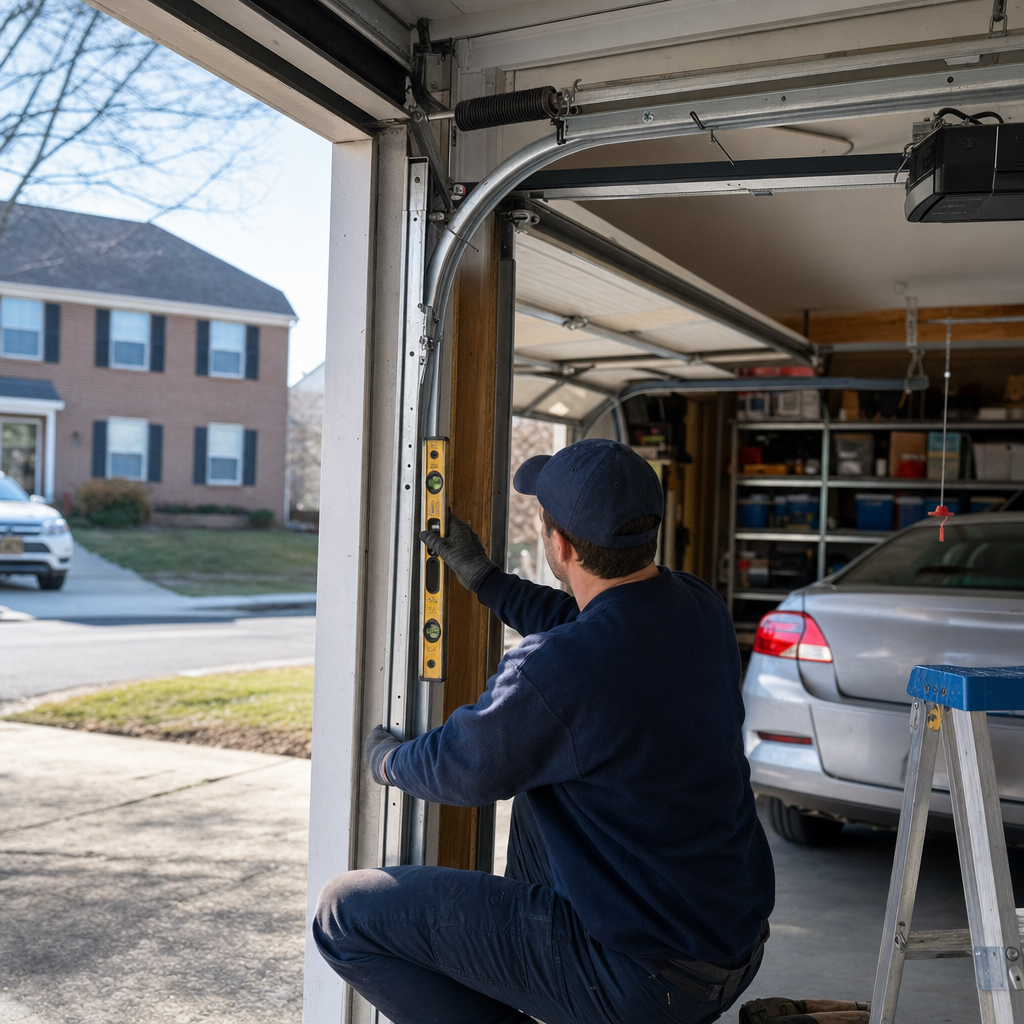
For non-urgent concerns — noise, slow operation, remote inconsistency, or planned upgrades — schedule during regular hours and avoid emergency premiums. Summit Garage Door Installation Maryland offers free estimates in Baltimore — call (833) 991-6997. Michael shows up, not a crew you’ve never met. From emergency repairs to full installations, one call covers it.
Frequently Asked Questions
Standard 16×7 insulated steel door installation in Baltimore runs $1,800–$2,600 including removal, disposal, permits, and basic opener. Premium construction with high-cycle hardware and smart opener ranges $2,800–$3,800. Wood doors start around $3,500 with higher ongoing maintenance costs. Call (833) 991-6997 for an exact quote — estimates are free.
Standard 10,000-cycle torsion springs last 7–10 years in Baltimore, shorter than manufacturer estimates due to freeze-thaw stress and humidity corrosion. High-cycle 25,000–30,000 springs extend this to 12–15 years. We replace more springs in March than any other month as winter thermal fatigue peaks. If your door feels heavy or the opener strains, the spring is declining — call before it breaks completely.
Galvanized or Galvalume-coated steel with baked-on finish performs best for most Baltimore homes — 15–25 year lifespan with basic maintenance. Aluminum eliminates corrosion concerns entirely and suits waterfront properties, but dents more easily. Wood and wood composite require resealing every 18–24 months; skip this and moisture infiltration destroys the core. We rarely recommend fiberglass in this climate due to thermal flexing and UV degradation.
Emergency garage door service is available for safety-critical failures — broken springs, cables off drum, doors that won’t secure. For standard repairs, we typically schedule within 24–48 hours across Baltimore city and county. Same-day availability depends on parts stock for your specific brand and model; we carry common components for LiftMaster, Chamberlain, Genie, Clopay, and Amarr systems. Call (833) 991-6997 to check current availability.
Repair makes sense when the door itself is under 12 years old, damage is isolated to one component (spring, opener, or panel), and the repair cost is under 40% of replacement. Replace when multiple systems are failing, panels are rusting internally, or you’re facing $800+ in repairs on a 15+ year door. We evaluate this honestly — 11 years, 117 reviews, one standard means we don’t push replacement when repair serves you better.
R-10 to R-12 suits most Baltimore homes with attached garages; R-14+ only if living space sits directly above or adjacent. Higher R-values without thermal break construction cause interior condensation in our humidity — we’ve replaced sweating “premium” doors with properly built moderate-R units that perform better. For detached unconditioned garages, R-6 to R-9 is sufficient.
The Bottom Line
Baltimore’s climate demands garage door decisions made with local conditions as the baseline, not an afterthought. Freeze-thaw cycles, Chesapeake humidity, and road salt exposure punish generic specifications and reward targeted material choices, proactive maintenance timing, and hardware upgrades that national guides never mention. The 15–25 year lifespan manufacturers advertise is achievable here — but only with galvanized or coated steel, thermal-break insulation, polymer or stainless hardware, and disciplined pre-winter maintenance. When you’re evaluating quotes, demand specification detail and question “standard” hardware. The owner is the technician. That changes everything.
Ready to spec a door that survives Baltimore, or need an honest assessment of what your current system needs? Summit Garage Door Installation Maryland home serves Baltimore with the same standard we’ve maintained for 11 years. Call (833) 991-6997 for a free estimate — Michael Brown handles the evaluation personally.
We also serve surrounding areas including Garage Door Repair in Silver Spring, Garage Door Installation in Silver Spring, and opener service throughout the metro region.
Written by Michael Brown, Owner & Lead Technician at Summit Garage Door Installation Maryland, serving Baltimore since 2015.